"Do you trust me?"
I have an absurdly long, rambling draft (well, multiple, actually) of an essay
discussing my observations and associated frustration with the inexpressiveness
of the English language.1 An illustrative example of one phenomenon that I
discuss in that essay, which has been the source of much frustration for me over
the years, is the titular question:
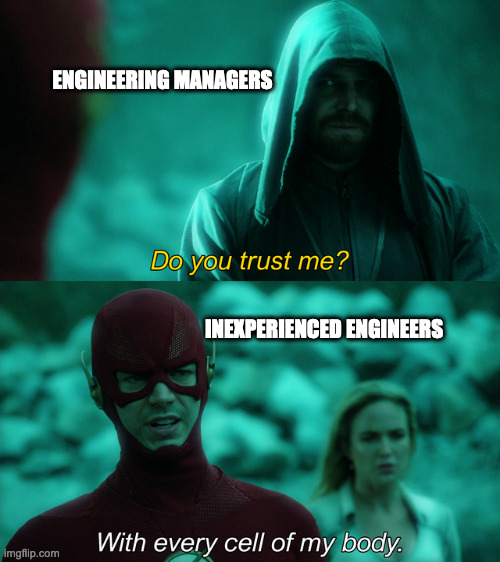
I find the word trust to be particularly fraught when used in a professional
and/or pseudo-professional setting, as the different meanings of the word
trust are easily conflated.
"Define trust…"
If we look at trust in the dictionary, we begin to see the
problem, as there are multiple, different, plausible options:
As a noun
assured reliance on the character, ability, strength, or truth of
someone or something
As a verb
to rely on the truthfulness or accuracy of : BELIEVE
and if we look at BELIEVE:
to consider to be true or honest
OR
to place confidence in : rely on
Using those definitions, we can project the original question into (at least)
two more expressive options, one or both of which may be what is intended by
the person asking.
- Do you believe I am behaving in good faith, with good intentions,
and sincerely doing my best?
- Do you have confidence in my context-relevant abilities?
The most common response when attempting to tease out this nuance in
conversation is resistance to even acknowledging that there are distinct senses
of the question. A surprising (to me) number of people seem to believe that the
answer to the second implicitly, necessarily matches answer to the first.
And, yet, I regularly encounter situations where my answer to one of the
questions for a particular individual in a particular context is "yes" while
the other is "no".2
An illustration
Consider the popular team building exercise of trust falls. In
high school, I worked at a summer camp which also had one of those ropes courses
that offer facilitated team building sessions. As a part of being staff at the
camp, we were divided into groups and went through a multi-day session,
including trust falls. In this particular case, there were two versions of the
trust fall.
For the first, all team members are standing on the ground and members take
turns falling backwards and being caught by one or two teammates standing
nearby ready to catch them.
For the second, the person falling stands an a platform six feet above the
ground and falls backward into a group of teammates, arranged in two rows facing
one another, with arms outstretched ready to catch the faller.
The first version of this is fairly low risk and harmless, barring a gross
size imbalance, even if a teammate in the catching role falters. The second,
however, presents a more substantial challenge for some of us.
By 16, I was larger than most of my peers at 6'2" at 225 lbs, particularly
compared to the rest of my cohort that day, which included a flyer on a local
cheer squad, who was at least a foot shorter than me and half my weight (or
less).
While I fully trusted the good intentions of my cohort and believed they
sincerely intended to do their best, the readily observable facts about their
relative size and strength—based on observing them working through the
more individual components of the course—undermined my confidence in their
ability to actually catch me in a way that was safe for everyone. And, of
course, I wouldn't be sharing this anecdote as an example if that skepticism
had not been borne out. Rather than actually catch me in the way that we had
caught everyone else, they merely managed to break my fall enough to prevent
injury.
"Presume good intent."
The most common breakdown I've observed in professional settings related to this
arises when an individual or group expresses skepticism or feeling uneasy about
a course of action and they are admonished to "Presume good intent," or "Give
the benefit of the doubt," or "Show some trust," or similarly pithy and
dismissive response rather than engaging the uneasy individual with curiosity.
In my experience, such responses always exacerbate the uneasy feelings.
The problems with these responses are twofold. Such responses often stem
from confusing an expression of low or uncertain confidence in a person's
skill for an expression of belief that the person is behaving in bad faith.
Responses emphasizing goodness of character or sincerity of
intention cannot reassure a lack of confidence in skill or ability.
In the rare case where the expressed concerns are about insincerity of
intentions, responding with admonishment signals that the skeptic's perspective
is considered worthless, which, if true, is a poor basis for future
collaboration.
Accounting for (contextual) power dynamics
A common mistake made by managers (including executives) is that they believe
they're entitled to trust from anyone beneath them in the
organizational hierarchy. Managers do, of course, wield power, including the
right to make certain decisions, which, in turn, implies a reasonable
expectation of deference. But such deference does not imply trust in either of
the above senses.
Teams led by managers who misunderstand the difference between compulsory
deference and genuine trust (in either sense) tend to be brittle and crumble
quickly when they encounter adversity because they tend to require high-overhead
coordination, which is inherently slower to adapt to changing circumstances.
Managers who haven't earned trust in one or both senses are also much less
likely to benefit from informal support from team members, which is critical
in organizations working on complex, dynamic (read: interesting) problems.
It may take some managers a bit to recognize this organically, particularly if
their early management experience was in an organization where they'd already
established a baseline of trust. As noted above, managers undermine their cause
by responding to a perceived lack of trust with exhortations rather than seeking
understanding with genuine curiosity. If that exhortation is particularly
strident, they risk completely alienating team members who may look to leave
their team or the company.