Thoughts on Operational Responsibility [for Software Engineers]
I originally drafted this in 2014/2015 to help frame a
conversation around software engineers being on call. The primary audience was a
group of software engineers coming from a predominantly desktop software
background who believed they should not be on call. This memo was one component
of a very long conversation. This version has been lightly edited to elide
some contextual specifics.
Who is responsible for this?!
re·spon·si·ble: being the primary cause of something and so able to be
blamed or credited for it.
What happens when an application running in production starts failing at 2am on
Saturday? Do we wait until 8am Monday to fix it? Should someone be woken up to
address the problem? Who should we wake up if the acute problem is that the
application has started crushing the database server by fetching a set of data
from a SQL database row by agonizing row via an ORM that encourages
engineers to reason about iterating over a list of things backed by an
abstracted-away SQL database in the same way they reason about lists of items in
memory? Applications fail as a result of ineffective or surprising changes to
application code at least as often as they fail because of underlying
network/hardware/etc failures.
<!-- prettier-ignore -->
Figuring out who to blame or even the notion that anyone is "to
blame" is not, it turns out, particularly useful. When an application is
materially broken in production, the most useful action is to rapidly identify,
assemble, and deploy the group of people who are best equipped to resolve the
problem.
Highly empowered software engineers
At [this company], engineers have a very high degree of functional
authority over production applications. A relatively large number of engineers
have direct access to our production systems with broad permissions.1
Developers deploy their applications when it suits them. Developers generally
have a high degree of influence in choosing which subsystem technologies their
applications use.
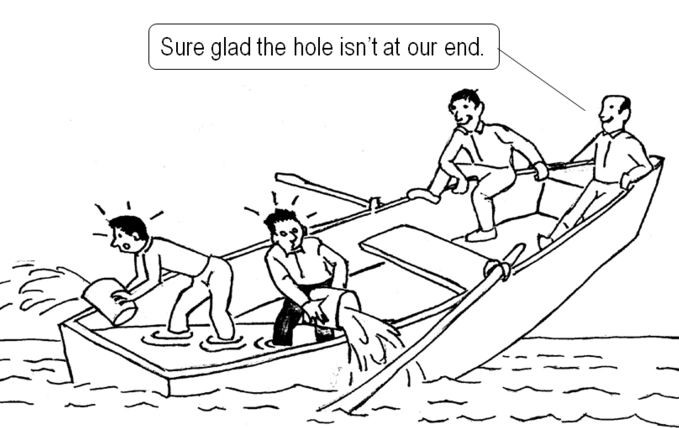
Broad access to production and the freedom to write and deploy applications
without first seeking approval from Ops, however, has not automatically resulted
in engineers expressing a commensurate sense of responsibility for the overall
health and functioning of their running applications and/or for the entire
production system.
With great power comes great responsibility
re·spon·si·ble: having an obligation to do something, or having control over
or care for someone, as part of one's job or role.
 2
2
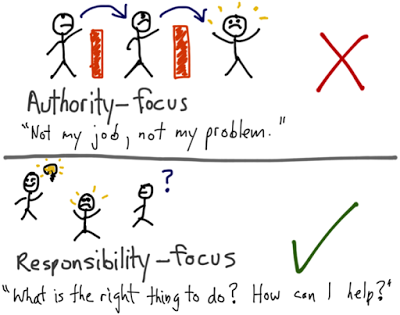
When we acknowledge that Ops and Development are corporately responsible for
the health and functioning of production applications, our focus can shift to
the question of how to better work together before, during, and after
applications are deployed to production and delivered to customers.
What does operational responsibility look like, practically, for an engineer?
- All engineers working on web applications or services, but particularly
those with production access, are expected to understand the production
environment itself and effectively wield the tools used to monitor and
manage the overall health of applications and services in production. This
includes making sure that the alerting systems are reasonably configured to
minimize false alarms
- Developers must understand the demands their application will place on
resources and collaborate with Operations to prepare and maintain a healthy
production environment. This includes capacity planning.
- For any web application or web service, there is an engineer with production
access available 24/7 to deal with issues related to their application–even
if that application doesn't have a 24/7 SLA.3
- That engineer is configured to receive via an interruptive channel all
appropriate and necessary alarms and notifications related to application
health during those times when they are scheduled to be available. As an
organization, we should minimize the number of people expected to be
available 24/7 365 days a year.4
- All engineers with production access make contact information available
(cell phone or functional equivalent) to Ops and other Development teams.
What if I get an alert, and it turns out to be a network/disk/hardware problem I can't personally solve? Can I just go back to bed?
If the other responders say, "We've got this, go back to bed", sure.
Otherwise, roll up your sleeves and figure out how to help. When things are
broken in a material way, the goal isn't to return you, individually, back to
your regularly scheduled activity (in this case, sleep). The goal is to get the
organization's systems and services back to an acceptable state. Everyone gets
back to normal the sooner this occurs; in the meantime, help.
Maybe the solution to the problem isn't to wait for the existing underlying
subsystem to be fixed. Maybe instead you can work to get your application spun
up on alternative gear. Maybe your application is up and running but another
team is struggling and could use a hand—lend it. Volunteer to transcribe status
updates via the appropriate communication channels.
Now, there will definitely be situations where there isn't anything you can help
with. That's fine. When that happens, confirm that there isn't any other way for
you to be helpful, let them know how to get ahold of you when/if your help is
needed and go back to your regularly scheduled activities.
Language, architecture, code structure, code style rules, method naming,
exception handling approaches, pattern choices, testing methodologies, and
development/test environment setup are all be tools in service of producing
reliable, performant, operable, production software in production which
delivers value to customers.
<!-- prettier-ignore -->
Other ideas related to this that deserve more attention at a later date
- Use the same tools/subsystems in development and test as you do in
production.
- Simplify your tool chain and the set of subsystems you use as an
organization.
- Prefer discoverable, explicit patterns over magical ones.
- Avoid dependency injection auto-wiring and don't configure dependency
injection externally unless absolutely necessary.
- Use AOP judiciously—it often obfuscates the source of system behavior.
- Be wary of tools that promise to abstract away your need to understand
the behavior of the abstracted away subsystems (e.g. heavyweight ORMs).
See Also
<!-- prettier-ignore-start -->
<!-- prettier-ignore-end -->